Friday, November 20, 2009

Thank You Jajas!

It’s been an exciting week for the women of Suubi. 56 women opened up a savings account through a microfinance institute in town. This way they’ll be able to save more easily for their children's school fees, for long term goals, or for a “rainy day fund.”
(4 Suubi Women waiting together to open up their accounts)

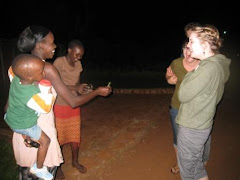
(We ran into 5 Suubi ladies on Main Street, they were just coming back from a group outing at the bank)

After 2 generous donations from my Jajas (Grandmothers) to “do whatever you see fit.” I started researching how to open up savings accounts. At first I was very disappointed in the banking system here; too high of fees, too low of interest rates, and too many penalties. It seemed the traditional banking route could potentially achieve the opposite of what we were trying to accomplish, by bankrupting these women in their attempts to save. The banks here in Uganda are only meant for the rich to save. But PRIDE Microfinance was the perfect institute for poor women to start saving and build up their accounts. There are no monthly fees, free deposits and withdrawals, and decent interest especially if the women are willing to leave their accounts untouched for a couple months at a time.
Last week when I told the women about how my Jajas were going to cover all the initial costs of opening an account and I would deposit a start-up fund to pad their bank accounts, they were very excited. I mistakenly told them to take the week, ask their husbands and think about whether they wanted that added financial responsibility. I didn’t realize I used the phrase “ask your husbands,” when I meant “discuss with your husbands.” And good old Translator Betty took the liberty to add to her translation, “Or don’t ask your husbands and open the account in secret.” The women got a good chuckle out of my mistake.
This week the women were told to gather their identification documents and photos and head down to the bank to sign up for their own personal accounts. It was such a satisfying experience when walking on Main Street to see a cluster of Suubi women all dressed up for their big day at the bank. Some of the women signed their own names; some of the women had purple thumbs marking their certification. I congratulated the women for taking the initiative to gain financial peace in their future.
Over and over the Suubi women have told me to thank my Jajas for their gift; so publicly on behalf of Suubi, “Afoyo Matek.”

(Rose making her first deposit)

Saturday, November 14, 2009

The Many Odors of Jinja

One of my weakest senses is my sense of smell. Because of that I occasionally miss out on the fresh whiff of a floral arrangement, but usually my lack of smell is more of a blessing than a curse (if you know what I mean). But this week, I have been sick with the flu which has perked up my lagging fifth sense. My nose is hyper-sensitive to any sniff, and let me tell you, Uganda is not the place you want to revive your aroma-meter. Everything here has a stench. Half the time I’m walking down the street this week I have to plug up my nostrils so my gag-reflex doesn’t kick in. I won’t get too graphic, but I will point out some of the major offenders:


Burning Trash-I’ve heard rumors that Americans have left Uganda with serious lung problems due to this environmental hazard. The odor is as repugnant to my nostrils as the air is to my lungs.


Cesspools of Standing Water-Divots in mud roads gather sour puddles after a rain storm.


The Fish Aisle at the Market-Even when just shopping for sunglasses, the fish aisle always conveniently wafts its way over to me.


Chicken feasting on Piles of Trash-It’s better than burning trash, but piles of garbage out in the open doesn’t produce a fragrant smell.

Body Odor-Deodorant isn’t widely used here, simple as that.

I can’t wait for my stomach bug to leave. I wait for the day when my dull sense of smell returns back to normal.

Saturday, November 7, 2009

Beautiful Betty

Light Gives Heat has some awesome new styles coming to a website near you in the upcoming weeks. So the six girls of the house went out on the town for a photo shoot to model the upcoming “flavors of the month.” They’ll be seen at LightGivesHeat.org over the next couple months. I think the necklace I modeled will be launched in February.


(Here’s the five ladies strutting our stuff down the Jinja downtown catwalk. From Left to Right: Rachel (Called Zebe), Emily, Me, Betty, Rebecca)


(Photographer and Make-Up Artist Rachel Stroud making us look beautiful)

Rachel whipped out her MAC Make-up kit and dolled us all up. This was Betty’s first time ever wearing a stitch of make-up. You can see how her natural beauty was just enhanced all the more. We had so much fun playing make-believe, but I had a very hard time taking myself too seriously. It was good to get out of the house with all the ladies of “Magwa House,” especially being able to hit the town with Betty, our housekeeper.


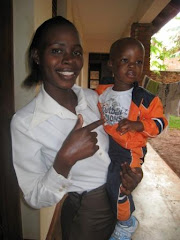
(Beautiful Betty)

Betty is going to be one of the people I miss the most. She is such an amazingly cheerful, silly friend. She has such a faith that the Lord has pulled her from her lowest low. She was pregnant with a child she didn’t even want, wandering the streets in the rain knocking on strangers doors asking for help after her family and the father of her child abandoned her. Today Betty can’t sing the Lord’s praises any louder, any time she tells her story she ends up preaching a sermon on faith and how good the Lord has been to her.
Unfortunately this week Betty has been the victim to a lot of deception and greed. Her half-sister, Nancy had moved in to help watch Kymbi while Betty goes to school. On Monday we learned that Nancy ran away from home, stole a lot of money from Betty and from LGH. Betty tracked Nancy down on the bus heading back to her village, but by the time Nancy got back to Kitgum, Nancy’s family took all the money and won’t send her back to Jinja. Betty has nothing in her but goodness, kindness and honesty. Sometimes if I give her money to buy me a mango (at Ugandan price not Muzungu price….way cheaper) she’ll fret over whether or not she owes me 5 cents or 10 cents. But Nancy has chosen to slander Betty’s name to her whole village from the North. Betty is a strong woman and says she is asking the Lord for faith in how to handle this situation so she does not act out of vengeance or hate. But it is difficult to watch how easily people can be taken advantage of, especially trusting, good people.
In the end, vengeance is the Lords. But I can already tell that as Nancy grows up in the village she’ll realize that she is reaping what she sewed. Her future looks very grim even thought a promising future was just years away. Nancy will probably now be stuck in her village fetching water for her dying mother. She will now only know her tribal language whereas she could have learned English and probably have gotten her education sponsored by someone involved with LGH. And because she has no education, her only option will include a young marriage to the first man that asks.
It’s hard to have felt like you knew someone and loved them like we all did with Nancy. We let her into our lives, invited her to come to “girls night,” tried to teach her English, played soccer with her, danced with her. So it hurts to know that the whole time she was plotting to steal money and deceive Betty so.
Keep Betty in your prayers. That she can keep her forgiving and compassionate heart, and not be hardened by this betrayal.

Thursday, October 29, 2009

It's Bank Day for Miriam!

This is my friend Miriam. She is about the encounter a very big step in any Ugandan woman’s life. Soon she will open up a Savings Account so she can save for her daughter’s education.


At the age of 13 Miriam was married off to a man who promised she was his only wife. After the nuptials were exchanged, she found out she had been deceived, and now ranks third among his tri-wives. From that young age when Miriam’s education stopped short, her goals of improving her status through education were replaced with a new goal of educating her 3 daughters, so they wouldn’t end up without options like she did.
Miriam is a savvy saver. Her husband gives her a little over $2 a week for food. She gets almost $10 a week from Suubi. And she works in town planting flowers for $2 a week. Miriam and 9 other Suubi women have devised a system that holds each other accountable when saving money. They rotate weeks where each woman gives one woman $5. So week 1, Suubi woman A brings home $50. But for the remaining 9 weeks, Suubi woman A gives $5 to the pot. Week 2, Suubi woman B brings home $50. Week 3 Suubi woman C brings home $50, and so on. This way all 10 women are held accountable to set aside $5 each week, totally $50 after 10 weeks. And because the money is out of their homes and their pockets, Suubi woman B cannot spend her savings, when it is Suubi woman A’s week to bring home her bulk sum. This system forces the women to think long and hard about how they will spend the $50 they’ve waited on for 10 weeks, rather than frivolously spend 5 more dollars each week without so much as a second thought. When Miriam told me about this grass-roots banking system, I was astonished at how genius it is. Last Saturday it was Miriam’s turn to bring home $50 and now she plans to open up a savings account.
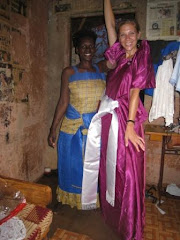
I joined Miriam for her meeting with the banker to make sure all her questions were answered and that she was signing up for the right kind of account. And let me tell you, Miriam usually dresses in style, but for her big banking day, she showed up dressed in a prom-like dress, a sequined shawl and glittery heels to match. I was so proud when walking down the street next to her that every head turned; not just because she is a knock-out, but because of she was wearing a new found confidence and assurance as an independent financially secure woman.

Monday, October 26, 2009

Reaping the Fruits of Others’ Generosity


(Patrick bathing with one sock on)

(Jacinta with her one year old son, Titus...As you can see little Patrick is still unborn at the time of the photo)

Early Thursday morning, a Suubi woman named Jacinta gave birth to a healthy baby boy. Her delivery story was about as routine of a birth as the next Ugandan woman. She walked to the nearest health clinic in her village around 9 o’clock the night before, racing against the final minutes of dusk so that the setting sun could light her path. She was in labor all night, and gave birth around 3am. And by the time the sun rose, Jacinta was had already left the clinic, and was walking back to her hut with her new baby boy swaddled in her arms. All within 12 hours Jacinta walked to the clinic, popped out a baby, and walked back home. No sweat.
Jacinta’s new bundle of joy will always have special meaning to me because she let me name her second born. She wanted to either name him after my father or my brother, so I let her choose between baby Richard and baby Patrick. She chose Patrick, so now this little tyke will grow up hearing the story of the origin of his name as this crazy Muzungu camera lady who had an older brother named Patrick.
Jacinta had no support leading up to the birth of her son. Her husband works out of town and she goes months without seeing him; and she alone has her hands full with a 1-year-old toddler named Titus. Jacinta knocked on a fellow Suubi woman’s door on her way to the Health Clinic, and this woman Joyce spent all night consoling her through a very painful and lonely birth. I tell you all this story to let you know that many of you did your part in America to ease Jacinta’s burden. Jacinta wasn’t given a baby shower before her delivery, in fact, no women in Uganda are showered with gifts awaiting the birth of their baby. And yet do to many generous donations from family and friends, we’ve been able to provide a necessity to 10 expectant Suubi women. In Uganda a woman has to bring a “birthing kit” with all her medical and hygiene supplies to the clinic in order to give birth. Most women are barely making ends meet, so even though they are given a 9 month warning to start saving up to buy a birthing kit, many woman fly by the seat of their pants. That is the case with Jacinta. She was actually 20 days past her due date, and did not have a pair of surgical gloves to her name.


(A while bunch of birthing kits)

With the support of many generous souls and the proceeds of a successful family garage sale, I am in the process of delivering 10 complete birthing kits to the homes of pregnant women in Suubi. Already one woman, Lillian who is 9 months pregnant, said it was such an answer to prayer she believed we were angels. I tell you all this to thank many of you for your donations and trust when you earmarked it as “do with it as you see fit.”


(Lillian and kids hugging her birthing kit)

I wanted to share this success story with you all so you too can feel good about how you’ve helped the women of Suubi. I may get the honor of naming the baby, but you all should feel honored to have helped ease these women’s burdens. Jacinta’s friend and first mate, Joyce told me that the birthing kit was unbelievable helpful for a smooth and safe delivery. In Uganda, once the labor pains begin, women are forced to think and act in survival mode. So any comfort or assurance they can have about their delivery brings these new mommies much needed peace of mind.

Monday, October 19, 2009

Riding Public Transportation in a 3rd World Country


(Riding Mass Transit)

My boyfriend Nick says the best way to experience a culture is to ride their public transportation system. I agree with him that it teaches you to travel the way locals do. But after my recent voyage to Sippi Waterfalls, I also think riding public transportation is a good way to grow jaded with the culture.
In Uganda there is no such motto as “the customer’s always right” or “your comfort is our priority.” In fact it’s exactly the opposite. Our adventures navigating to Sippi Falls can attest to a new business model of treating customers like cattle. We were to take a Matatu (taxi van) to Mbale, a city that could take anywhere between 90 minutes to 5 hours to get there, depending on the drivers perseverance to make money.
The first lesson we learned was that the Matatu doesn’t take off unless the whole cab is packed full. A notice inside the van stated capacity to be at 14. Slowly but surely the van filled up to 14 after an hour of waiting in the smoldering, cramped space of the cab. But “capacity” here isn’t limited to the number of seats. Most drivers make it their personal mission to make the biggest bang for their buck before starting the engine. So after another hour of claustrophobia, we were able to hit the road with 20 passengers squeezed 4 to a row. Kind of like those early high school days of pilling as many kids in the backseat as hip room would allow.


(One of the many street vendors making a buck on the go)

I won’t go into great detail. But suffice it to say that after 1 flat tire, 2 pit-stops in various towns so street vendors could patronize our windows by selling mystery meat on a stick, and a few small elbow nudging victories that got me a little extra space; we arrived at in Mbale 5 hours later.


(A flat tire, just one of the many pitstops)

But the fun doesn’t end here. On our return trip to Jinja the Matatu drivers surprised us with another new business model. Cramming 22 passengers inside that same “14 passenger van” wasn’t making enough of a profit, this time the passengers were expected to hold appliances on their laps. These Matatu drivers are smart. Why limit transport to just people? Why not pile chairs, tables, and charcoal on top of the van, force passengers to carry televisions and wooden pallets on their laps, and toss a couple live chickens in the back of the van while they’re at it? We began to look for that euphemistic kitchen sink to fill up the last of our breathing space.


(The top of the van, packed with random cargo...can you spot the kitchen sink?)

One could say this way of transit is the most economic and environmentally conscious way to travel. Maybe rather than trying to build expensive, invasive public transit systems in America, we just need to pack our vehicles full like sardines. Now that I’m finally able to breath deeply and my bruised ribs are healing from those vicious elbow wars, using the Ugandan model of mass transit doesn’t sound like so bad!…Let’s all forgo those silly safety regulations like seatbelts and working brakes, next time you want to “Go Green,” hitch a ride in a livestock carrier, just make sure to offer to hold any extra cargo they may be transporting.


(This sunset made the ride all worth it)

Friday, October 16, 2009

Dancing Queens


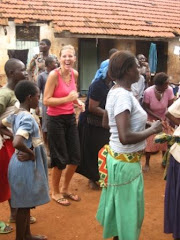
Imagine coming home from school one random Wednesday, only to see your mom who usually is doing her typical domestic duties, dancing, chanting, and cheering with 50 of her closest friends? That’s what the kiddos of Suubi saw Wednesday evening when their moms attending the first ever “Suubi dance class.” It took place right outside the Suubi building on the streets of their village. The dance party lasted 2 hours and drew quite a crowd of nosey neighbors.
Many of these women grew up in the village where the dancing rituals were passed down from mother to daughter. But some of the Suubi women fled from the war against Kony and the rebels as children, so they have never learned how to shake what their mama’s gave them. We will now host weekly dance lessons for the women of Suubi, so they can express themselves in the same way their female ancestors have for centuries.
Our usual encounters with the women are very cordial, polite and proper. During the week we enter their homes, chit-chat about various topics, and occasionally help with their household chores. On Saturdays the women sell us their necklaces, and we get see their pleasant smiles when they count their money or their rolled eyes when we refuse to buy a poorly made necklace. But on Wednesday I got a chance to see a brand new side of these women. It was the pure, unabashed joy that only dancing can create. Big smiles, loud African yodeling (I can’t think of a better way to describe it), and these “moms” were transformed into “divas.” Rebecca, Rachel and I kicked up our heels for a few numbers, but even after over 30 years of dance training between the 3 of us, our bodies just couldn’t move that way.
It was a day that was good for morale. Suubi isn’t just a business. It’s definitely not a hand-out. It’s a community meant to empower women, but that’s not just accomplished with money. Sometimes you just have to dance to feel strong and free.